Designing a mobile app for bicycle renting services

Understanding Brief
“ Design an app to help people explore, decide and book a bicycle that they can pick up and use for the booked time.
Design a bicycle rentals service in certain major cities for tourists and locals alike. The service has a few bicycles placed across the city at many designated spots. People are required to pick-up and drop bicycles at these spots for which they would be charged per hour.
Understanding Scenario
Almost every city are evolving rapidly in our country and transportation will be a major issue. Bicycles provide a quick and easy way to cruise through traffic and cities all over the world are adopting bicycle rentals.
The aim was to design a bicycle renting app for urban spaces. Locals and tourists can pick-up and drop their rented bicycles all around the city. Their usage will be counted in hours. Although this system’s been implemented by some, the experience still needs to be refined to delight users.
I challenged myself to be as rapid as possible and to figure out the experience of the core flow. This whole project was done in four days, and I’ve tried to be my most efficient through the process.
Research Phase
People chooses a bicycle mainly for one of these —
1. Wants a quick and cheap ride (a little more than walking)
2. Specifically wants a bicycle ride (health, ecology, cruising through traffic, all the advantages of a bicycle come under this)
Secondary Research
Looking at existing solutions, it quickly became apparent that while the basic system was same, every implementation was a bit different - intentional or not, this lead to different mental models over time. For instance, Pedl links to your Paytm e-wallet, and manages payments seamlessly. Citi Bike requires you to buy passes and use it for the bikes, eliminating payments for the ride itself.
Over time, it became clear that the user doesn’t want a bloated app that lets you rent bicycles. They want an app to just rent a bicycle - as simple as possible. There are full fledged apps for other things like tracking fitness or getting directions to a place. This meant that every feature added above the core functionality should be critically considered.
Ideation
It was a fairly straightforward product, so I started thinking about what the user faces at each step in the process. After a few rounds of brainstorming, brain writing and lateral thinking methods, I had a set of ideas that can be merged together and made into a refined bicycle renting app.
For pick and drop
For pick and drop it seemed best to follow the scanning via QR code, with an app which shows the number of cycles available at each station or (NFC) modules to communicate between the phone and the bicycle.
Why?
By taking the information of the user:
1. It’s easier to track the cycle
2. This can reduce the chances of theft
3. Avoids the hassle of losing a key or lock
The rack in station would allow the certainty of cycles and reduce the chances of the cycle getting lost.
For Safety
For safety reasons, having a Bluetooth enabled earphones for announcement and notifications and also a mobile holder in front of the app for easy navigation while riding a bike.

Scope
Why?
A bicycle renting app for urban spaces. Locals and tourists can pick-up and drop their rented bicycles all around the city. Their usage will be counted in hours. The app will focus on the user’s experience while using the service. There’s a lot of vehicles on road and lot of traffic people want a neat solution. Also, bicycles have numerous advantages over other vehicles.
Where?
Mainly for city spaces where cycle stations can be setup all around with enough flow. Urban Settings also ensures high frequency of usage due to high traffic.
When?
Right now. India has a rapidly growing urban scenario and generally a huge traffic. We might really benefit from a bicycle hared renting system mainly in fastly growing under-planned cities.
Assumptions
One bike for all
A standard well designed bicycle made specially for the urban spaces.
Locking mechanisms
Electronic locking mechanism with NFC and solar charging.
Smart station
careful planning and strategic placing of parking station for the cycles is needed to ensure smooth flow of cycles from one station to other.
Dependencies
Near Field Communication (NFC)
modules to communicate between the phone and the bicycle. When this is unavailable, alternative methods like high frequency audio or QR code can be used.
Machine learning algorithm
Electronic locking mechanism with NFC and solar charging.
Smart station
That runs on the cloud and calculates availability of bicycles and provides Accessibility Index.
Payment System - Access Tickets
Tickets are metaphors for access. The user buys tickets, then uses those tickets to unlock cycles and use them to access bicycles.
But why a ticket system? It settles the issue of remaining time. Services are to charge for the usage on a per-hour basis. It confuses sometimes as to a lack of relation between what you are charged and what you used. A ticket system solves this .
Availability Index
What if user chooses a station, walks towards it and when user reaches it, the bikes are all taken? This poses an interesting problem. Although most of these cases can be avoided by careful planning for the station locations, very few edge cases will be unavoidable due to high drop-low pickup stations .
Availability index will be a machine learnt algorithm that’ll consider the following factors and suggest the best station nearby -
- Distance from the user
- Number of cycles available
- Number of people approaching the dock
- Number of cycles approaching the dock
The number of people approaching the station is calculated by the number of people selecting the station to view and moving towards it. This gives the user an approximate idea of availability, and this all happens under the hood.

What the user sees is a cycle icon that is green, yellow or red based on the availability. The planning and self sustainable circulation systems ensure the icon stays green most of the time, and the user only needs to make a choice when the icon goes red. This covers any edge case scenarios and ensures smooth experience to all users.
App Flow
On-boarding ----- Finding near by stations-----scan QR code/NFC unlock system---plan a trip---- Enter destination---pop up about trip---green areas indicate safe routes and red areas indicate unsafe---can lock or pause or end trip---end trip find near by station----user can see how many tickets use and distance covered .
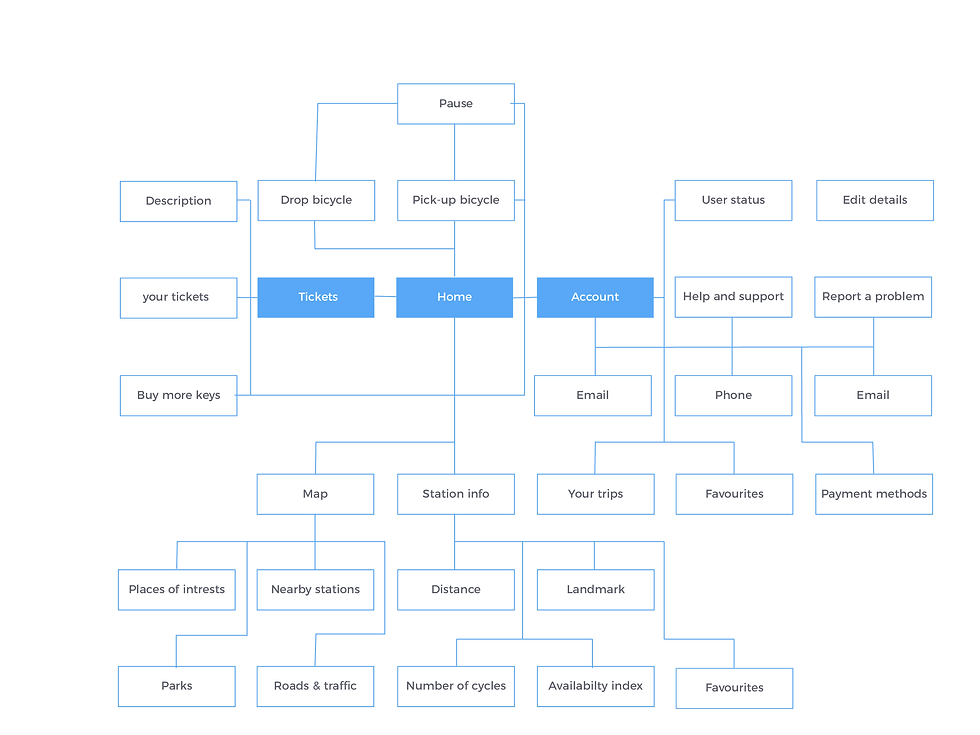
Information Architecture
Visual Design
Design the application in way that so user will be not overloaded with lot of information. The station can be viewed, added as a favourite so that the user can look up the station if he wants to. It only shows you what you can do at any point in time. It doesn’t try to encompass everything into one. For instance, the whole flow of picking a bicycle is only possible after you reach a station.
User Flow

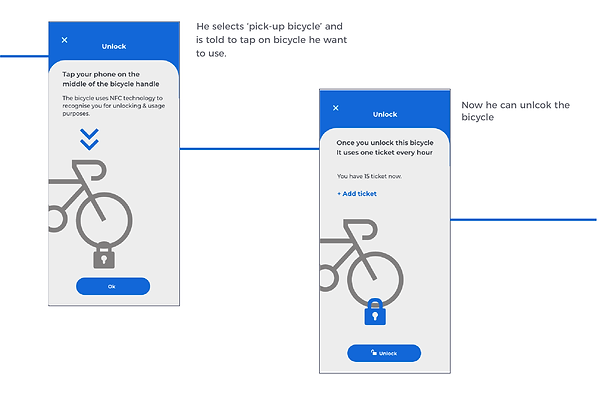


Interactions
Above this, all interactions and micro-interactions will play a major role in providing a simple and clear experience to the users. There were a lot of decisions made, like the exclusion of the users face from the profile simply because it’s not needed.
In the End
Of course this is sort of the Minimum Viable Product, and I put my best effort to focus on the core experience and the mental model of the app. The intent was to focus on providing a sense of joy, more than a functionally equipped app. This still needs structured user testing and refinement, and adding secondary features and flows.